DIW Economic Outlook Autumn 2025
German economy poised for upturn thanks to fiscal package; uncertainties in the global economy
- German economy emerging from economic slump; after a bumpy start to the year, things are slowly looking up; small growth of 0.2 percent expected this year
- Upturn imminent thanks to fiscal package for infrastructure and climate protection, higher defense spending and tax incentives for investment
- Economic output expected to rise by 1.7 percent in 2026 and 1.8 percent in 2027
- Growth mainly supported by domestic demand, with foreign trade losing importance; structural problems in the German economy remain
- International environment characterized by uncertainty, US tariffs weigh on many areas; global economy expected to grow by 3.7 percent in 2025, 3.3 percent in 2026, and 3.5 percent in 2027
© DIW Berlin
German Economy
Public spending concealing structural problems of German economy
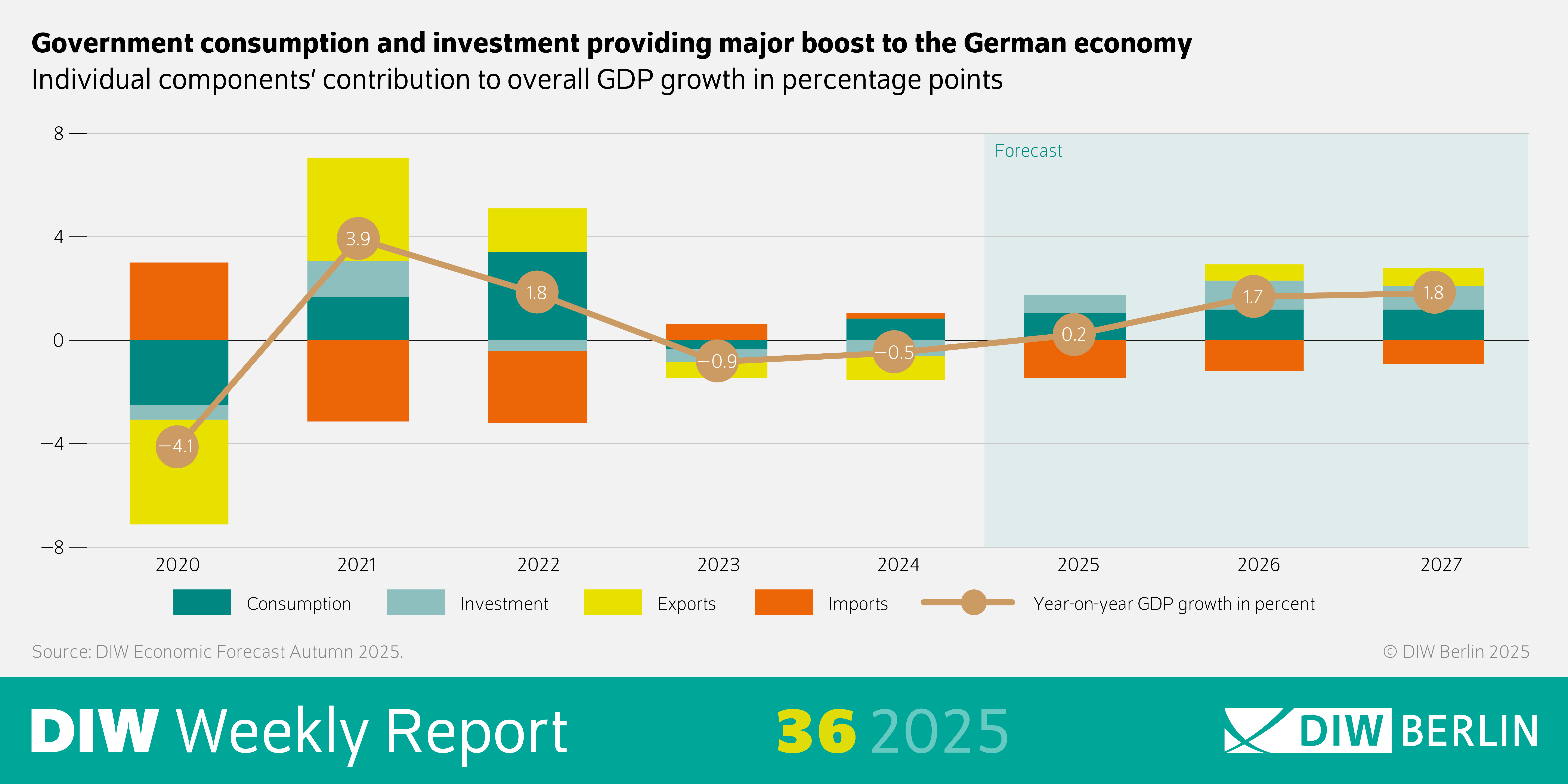
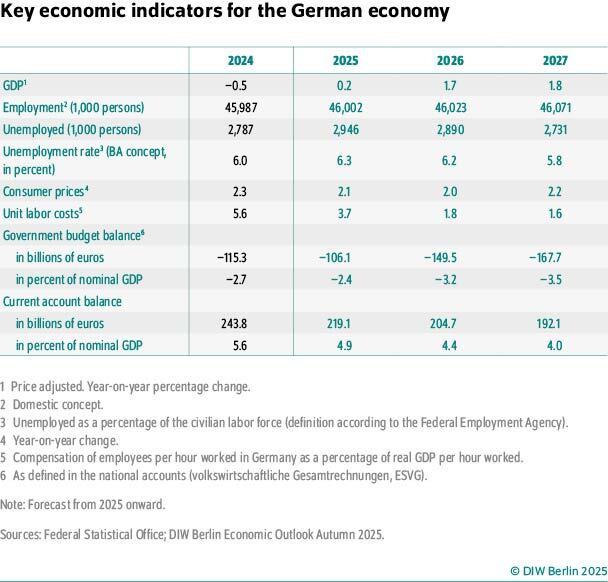
The German economy is gradually emerging from its slump. After a bumpy start to the year, which was marked by special effects related to customs duties, growth this year remains subdued at 0.2 percent overall. However, the economy is already gradually picking up speed in the current third quarter. In the next two years, this will translate into noticeable economic growth of 1.7 and 1.8 percent, respectively (Table: Key economic indicators Germany).
© DIW Berlin
The main drivers are the extensive financial package for infrastructure and climate protection, higher defense spending, and tax incentives for corporate investment. These measures primarily stimulate government consumption and public investment, even if—as assumed in this forecast—the funds are disbursed at a significantly slower pace than estimated in the current draft budget. However, as production capacities are currently underutilized, there is at least a chance that planned projects will be implemented quickly. Nevertheless, the expansionary fiscal policy only masks the structural weaknesses of the German economy. Industry is in crisis: high production costs, declining competitiveness, and demographic trends are slowing momentum.
“The German economy is, unusually, not recovering from strong foreign trade, but rather from domestic activity, especially the expansion of the public sector. The positive effect of the massive public funds will mask the structural growth problems in Germany over the coming years.” Head of Forecasting and Economic Policy Geraldine Dany-Knedlik
Traditionally strong foreign trade continues to lose importance. The economy is mainly supported by domestic demand. Private consumption continues to grow, albeit at a subdued pace. While the current high level of unemployment and associated job concerns are still acting as a brake, a more favorable situation on the labor market should provide greater security again from 2026 onwards. Rising real wages and lower inflation are also providing support.
Consumer price inflation is expected to be 2.1 percent this year. In 2026, it is likely to be exactly in line with the European Central Bank's target of 2.0 percent, and in 2027 it is expected to rise slightly to 2.2 percent as a result of expansionary fiscal policy.
Global Economy
Aggressive US trade policy weighing on global economy
After exports to the US were brought forward at the beginning of the year due to fears of tariffs threatened by US President Trump, there was a slump when the new trade barriers came into force. Although the provisional agreement between the EU and the US has stabilized the situation somewhat and reduced uncertainty, trade barriers and the comparatively strong euro will continue to weigh on German exports. Robust demand from European partner countries is providing some relief.
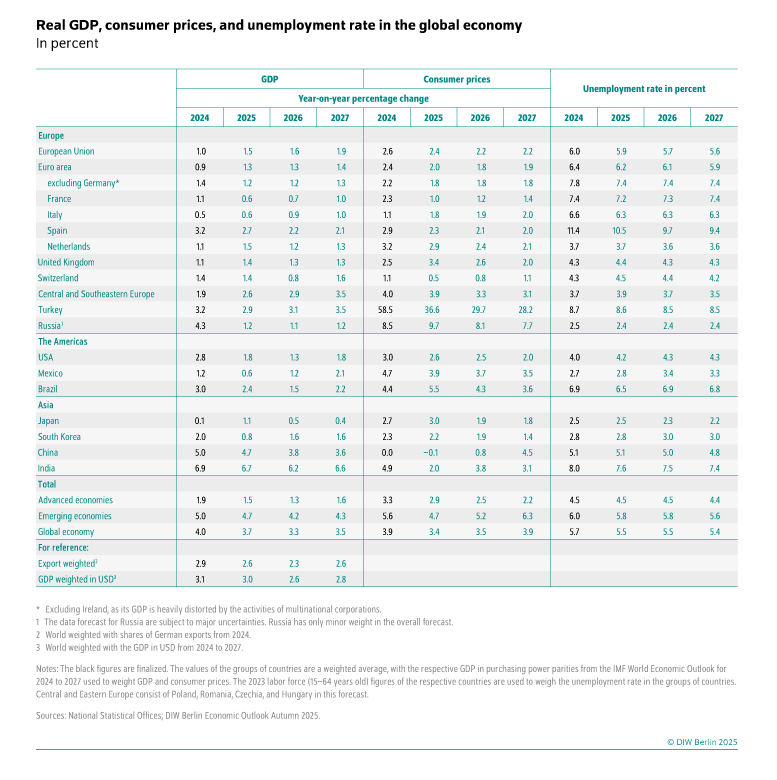
The international environment remains characterized by considerable uncertainty. The US government's tariff policy is weakening global trade and increasingly affecting the United States itself. In China, the real estate crisis and structural problems are weighing on growth. Emerging markets remain the engine of the global economy, while advanced economies are weakening. Overall, the global economy is expected to grow by 3.7 percent this year, 3.3 percent in 2026, and 3.5 percent in 2027.
© DIW Berlin